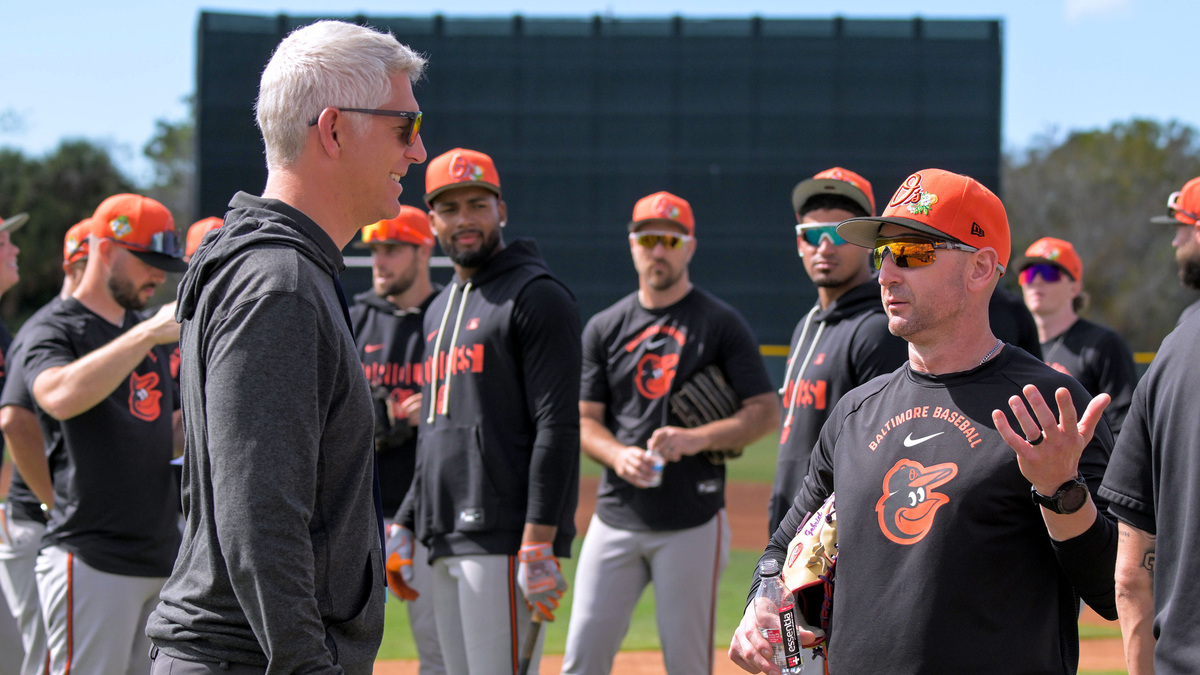
Josh Tolentino: How GM Jared Banner’s ‘relentless’ approach can shake up Orioles
BALTIMORE – Not long ago, the Baltimore Orioles faced the enviable problem of fitting all their promising young hitters into one lineup. Getting those hitters back on track has become a far more urgent concern.
Read more Tyreek Hill Nears a Return From Knee Injury, Per Drew Rosenhaus, as Rams Lose Davante Adams
That challenge awaits Jared Banner, Baltimore’s new general manager and formerly an assistant GM with the Chicago Cubs. He also held scouting and player development roles with the Boston Red Sox and New York Mets during a career that began in 2007.
Tyler Zombro, the Cubs’ vice president of baseball operations, pitching strategy who worked closely with Banner in Chicago, described him as “relentless” in his approach to player development.
Where should Banner start? For Zombro, the answer came without much hesitation.
“The offensive stuff,” Zombro said. “No doubt.”
There’s plenty to examine.
Gunnar Henderson’s OPS has tumbled from .893 in 2024 to .712 this season. The shortstop who hit .281 with 37 home runs two years ago finished 2026 at .225 with 24 homers. Second baseman Jackson Holliday hit .229 with a .640 OPS in 98 games. Outfielder Colton Cowser’s defense demands an everyday spot in the lineup, though his bat keeps making the case for a platoon role. Cowser’s .687 OPS improved from a dismal 2025 campaign but remained well below his .768 mark as a rookie in 2024.
Zombro recently discussed Baltimore’s disappointing offensive production with Banner, recalling how just a few years ago, the Orioles had assembled a formidable collection of young hitters.
“They just had all these young position players that could bang,” Zombro said.
That promise has given way to a much more troubling reality.
Collectively, the core’s production, or lack thereof, leaves a franchise built around homegrown offense with an urgent development problem at the major league level.
Banner, hired Monday, will lead Baltimore’s player development, coaching and performance efforts. He’ll also work with president of baseball operations Mike Elias on strategy and acquisitions, though Elias retains the final say.
That puts Banner in a position to work closely with manager Craig Albernaz, who enters his second season facing considerable pressure to get more out of Baltimore’s underachieving roster. Albernaz and his coaching staff will be essential to putting Banner’s player development philosophy into practice at the major league level.
Banner was also a finalist for the Athletics’ president of baseball operations position before accepting Baltimore’s offer, according to a source with direct knowledge.
Banner, 40, fills the general manager’s position left vacant after Elias was quietly promoted to president of baseball operations before the 2025 season. His hiring follows September’s departure of Matt Blood, the vice president of player and staff development, and the reassignment of longtime Elias lieutenant Sig Mejdal from overseeing analytics to focusing on emerging technologies and innovative practices.
Elias, who was hired in November 2018 and turns 44 in December, has now overseen eight seasons without a postseason victory. The division title and 101 wins in 2023 demonstrated what his operation could build, but consecutive postseason sweeps in 2023 and 2024, followed by consecutive losing seasons in 2025 and 2026, have exposed how far the Orioles remain from sustained success.
As the David Rubenstein-owned Orioles charge ahead, changing the executives and responsibilities around Elias must produce more substantial results than a revised organizational chart.
According to Zombro, Banner believes development should continue throughout a player’s major league career. With the Cubs, he demanded that coaches identify weaknesses in each player’s game and take responsibility for addressing them.
“He’s a firm, firm, firm believer that even major leaguers need to change and develop, and he pushes coaches on that big time,” Zombro said. “I think obviously [Alex] Bregman’s a different beast, but Bregman got coached just as hard as anybody else … His mindset is, yeah, you’re paying them, but they’re not all turnkey operations. They have to continue to get better.”
That expectation should resonate in Baltimore, where reaching the majors was supposed to mark the beginning of something much bigger for this group of hitters.
The Orioles have too often counted on their lineup to function as a turnkey operation, trusting that assembling enough talented hitters would eventually produce a dangerous offense. Instead, their best hitter this past season wasn’t one of their prized homegrown talents, but free-agent acquisition Pete Alonso, who led the American League with 43 home runs and 113 RBIs. Infielder Coby Mayo’s breakout (24 homers, 63 RBIs) offered a pleasant surprise, but his emergence couldn’t compensate for the struggles of so many established hitters. Frankly, nobody else on the Orioles came close to Alonso’s offensive production.
Opposing pitchers have adjusted to Baltimore’s hitters. The question is why the Orioles have struggled so mightily to adjust in return. Banner must help close that gap by demanding more from the coaches entrusted with getting the most out of this lineup.
Banner’s attention won’t be limited to the hitters. Zombro, who previously played under Albernaz in the Rays’ minor league system, said the new GM has already done his homework on starting pitchers Shane Baz, Kyle Bradish and Brandon Young, a trio expected to help anchor Baltimore’s rotation, with an eye toward how each can continue improving.
During his time with the Cubs, even a three-pound increase in a player’s weight could send Banner into the cafeteria asking questions, according to Zombro. He wanted to understand the daily habits that might affect a player’s performance. When several Cubs struggled with persistent blister problems, Banner went so far as to bring in an outside manicurist to help address the issue.
However obscure or unusual the problem holding a player back, Banner seems determined to find someone who can help solve it. Those details reveal how seriously he takes the responsibility of helping players improve, even when the solution requires looking beyond baseball’s usual expertise.
Read more No. 10 Utah, No. 14 Houston clash in matchup of high-scoring offenses
That openness also applies to how he evaluates talent.
Zombro said Banner doesn’t treat the organization’s analytical model as the final word on a player. If staff members see a credible route to improvement, he’ll consider their case even when the numerical assessment offers little encouragement.
Consider the case of pitcher Brad Keller, who entered 2025 with a career 4.34 ERA before joining the Cubs as a non-roster invitee on a minor league deal. Chicago’s analytical model wasn’t particularly encouraging about Keller, and Zombro recalled skepticism within the organization about signing him, even to a minor league contract. Zombro, however, believed Keller could be better than the numbers suggested. He had a plan to help the pitcher improve, and Banner was willing to back it.
“From day one, JB is like, he’s in the trenches with me on, like, I hear you. You think he’s better than this number. You say this is how you’re going to get him there,” Zombro said.
Banner’s willingness to trust that evaluation paid off. Keller posted a career-best 2.07 ERA across 68 appearances that season.
Banner also played an instrumental role in the Cubs’ acquisition of outfielder Pete Crow-Armstrong, whom he had known from their time together with the Mets. When Chicago pursued a trade involving Javier Báez in 2021, Banner strongly advocated for acquiring Crow-Armstrong, who has since emerged as one of baseball’s brightest young stars and the overwhelming favorite to win the 2026 National League MVP award.
“It was great having Jared in the room, Pete was the guy he was particularly high on and really sang his praises as a person, his defense, really how special [Crow-Armstrong] was,” Cubs president of baseball operations Jed Hoyer said. “He was a huge voice in the room in favor of Pete. It’s worked out well. Jared deserves a lot of credit for that acquisition and his success.”
“JB reads the player, he reads the personality, he reads the work ethic, and puts a lot of … valuable stock into that,” Zombro said. “Because ultimately, if a player doesn’t have that in his DNA, it’s going to be hard for him to adapt and get better.”
That’s precisely where scouting and development meet. The numbers help assess a player’s current ability, though unlocking more requires sound judgment and coaches who can earn the player’s trust in a plan to improve.
The Orioles should welcome Banner with open arms, considering they have ample reason to question whether their assessments of certain players still hold, and whether their methods are helping those players respond when the competition catches on.
Banner has spent nearly two decades learning how successful baseball operations function, collecting three World Series championships with the Red Sox along the way. His career began in Boston’s player development department in 2007, the first of 11 seasons during which he climbed the organizational ladder and worked alongside accomplished executives including Theo Epstein, Dave Dombrowski and Hoyer. A Brooklyn native and former Amherst College baseball player, Banner eventually rose to vice president of player personnel, gaining experience in scouting and development before leading the Mets’ player development operation and joining the Cubs in 2020.
“Jared has been one of the rising talents in our league for some time now,” Elias said in a statement. “He has demonstrated success running multiple different departments and has worked alongside some of the best people and front office talent in the league across multiple stops. He is a perfect fit to grow, evolve and improve the Orioles’ baseball operations.”
Elias wants Banner to help the Orioles evolve. Is he willing to do the same?
Multiple sources have described Elias as an executive who can operate with blinders on, making it more difficult to recognize weaknesses in the organization he built.
The hard truth is that Banner’s influence will depend on whether Elias is willing to confront the weaknesses his new general manager identifies.
Entering his ninth season in charge, Elias still presides over a baseball operation shaped by his preferences, staffed by his hires and governed by his decisions. Banner brings a different perspective, but Elias retains final authority. The value of this partnership will depend on whether Banner has a meaningful voice in those decisions.
Welcoming another voice is easy when everyone agrees. The disagreements will tell us more.
Banner, at least, appears comfortable having uncomfortable conversations. Zombro described him as “relentless and ruthless” in delivering messages, but emphasized that his bluntness is backed by a sincere investment in helping players and coaches collectively succeed. Those in the warehouse will need to hear him out, take his criticism seriously and match his commitment to getting more out of this team.
“He’s going to push people to get better. No doubt about it,” Zombro said. “It’s who’s going to rise to the occasion and match his intensity to get to where they want to go.”
If Banner is going to challenge how the Orioles develop players, Elias must be willing to reconsider the methods he put in place.
Read more South Florida is feeling the 60s. How long will the cool last?
____
Copyright 2026 Tribune Content Agency. All Rights Reserved.
This story was originally published October 21, 2026 at 5:47 AM.





Post Comment