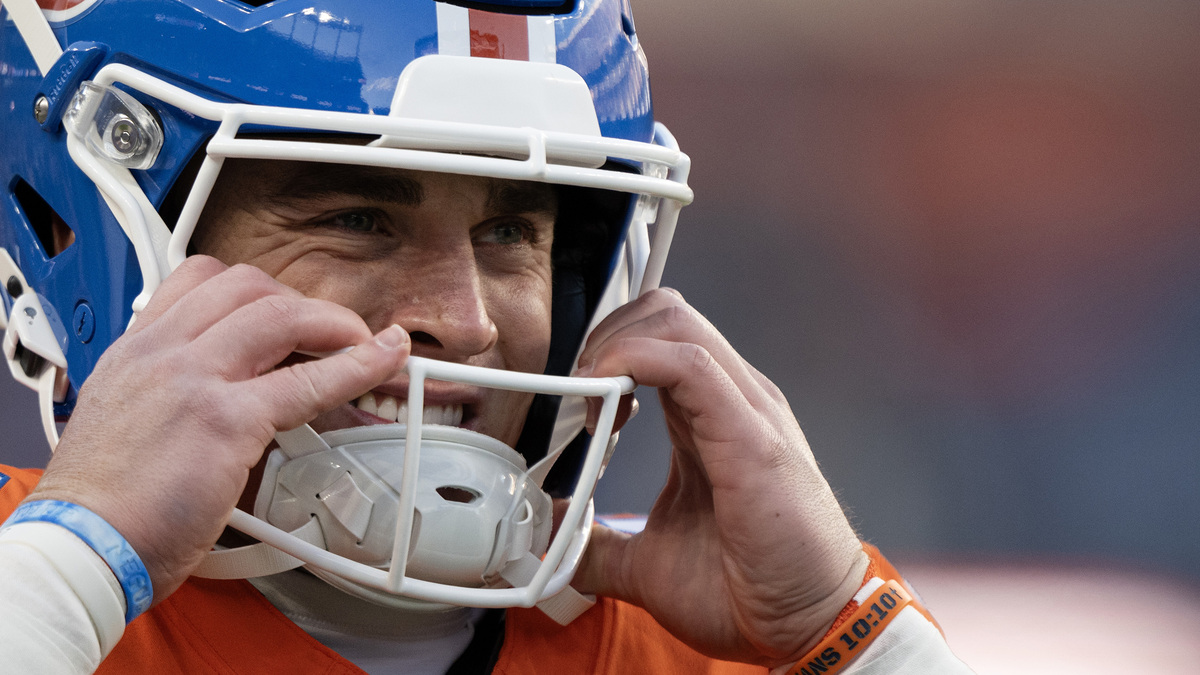
Sean Keeler: Broncos QB Bo Nix is playing scared. Here’s how Sean Payton can fix it.
DENVER – When he sees Bo Nix, Justin Anderson sees a man fighting The Bear. Only not the Chicago kind.
Read more Luke Fickell Gets Honest On Facing USC Quarterback Jayden Maiava
“When our attention gets locked onto threats, we activate our sympathetic nervous system, which is the defensive posture,” Anderson, a venerated sports psychologist, told me over the phone Monday as we discussed Nix, the Broncos’ mercurial QB1. “And it’s fight-or-flight. And that is really good if we’re fighting a bear. It’s not really great for these high-precise performance moments.
“If you’re concerned about making a mistake, your attention now becomes focused on what could happen there. And when that occurs, we get into what we call a ‘threat response.’ It’s really interesting research, from the brain standpoint.”
It’s also really,really boring offensive football. Nix threw for 107 yards in a “Thursday Night Football” showcase vs. Seattle, a potential Super Bowl preview. Bo averaged 3.2 yards per dropback. The Broncos won in overtime, 17-14, and did so in spite of No. 10 as much as they did because of him.
Anderson’s been there, by the way – he was a former quarterback at Minnesota Duluth. Even broke his ankle playing with the Bulldogs all those decades ago. He cowboyed up through a bum elbow. And what he came away with watching Nix on Thursday was a man scared to fail, a QB scared to make a mistake.
“What I saw is, I think, (was) a quarterback trying to manage the game,” said Anderson, the founder of Premier Sport Psychology. “I think what we’re seeing in a lot of places is, (quarterbacks) are being told, first and foremost, ‘Do not turn the ball over.’ And it makes a lot of sense, because in every (NFL) building, every analytics department is saying, ‘Hey, whoever wins the turnover battle wins the game.”
Only after six games, the Broncos are the NFL’s ultimate inkblot test. You can look at that little squiggle and interpret it any way you like. They’re 4-2 without having played four quarters, or even three, of complementary football yet. They’re still in the playoff hunt after a rugged opening six weeks that featured the best three teams in the loaded NFC West; a good Jacksonville bunch (4-2); and a road ambush by the still-unbeaten Chiefs (5-0).
Of the six defenses they’ve faced, four rank among the NFL’s top eight in fewest yards allowed. The 0-6 Chargers, however, opened the week 17th in that statistical category, and Nix and his mates managed just 224 yards of offense against them, too. So is it the head? Or the heart?
“There’s a science behind it. There’s a physical (side of), ‘Are you healthy, or not?’ All the other things (are) relative to the mental toughness, the mental fortitude,” Broncos coach Sean Payton told reporters Monday. “This is a tough league. We hit every aspect, and I think that’s one of the things that attracted us to Bo in the beginning is we had seen his ability to climb through adversity.”
Meanwhile, another sports psychologist, Dr. Pete Temple out of Mind’s Eye Sports Performance in Chicago, emailed me Monday to say he saw the same stuff that Anderson noticed from afar.
“I obviously don’t know what’s going on in Bo’s head, but I wonder whether he’s gotten away from trusting the process that made him successful in the first place,” Temple wrote. “For a quarterback, that might be as simple as: ‘Get the play. Make your reads. Let it rip.’
“When athletes become overly focused on outcomes – whether they’re worried about making mistakes, trying too hard to succeed, or concerned about what others are saying, it can interfere with their ability to perform naturally … (Nix) hasn’t suddenly forgotten how to play quarterback. But it’s possible that worrying about what might happen has interfered with his ability to trust what he already knows how to do.”
So how do you get that trust back?
1. Show him the good plays
Nix is 29-13 as the Broncos’ QB1, including the postseason. He’s 18-5 over his last 23 regular-season starts. No. 10 leads the NFL with three fourth-quarter comebacks and four game-winning drives. Remember Buffalo? The Jaguars? The Rams?
Read more After blockbuster trades, new-look Heat and Wolves clash in Miami
Good tape, affirming tape, is there. Go watch it, Temple says.
“If I were working with him, I’d probably have him watch film of himself playing some of the best football of his career,” the psychologist said. “Not to analyze his mechanics, but to reflect on what was happening mentally. What did it sound like inside his head? What was his energy like? His body language? His tempo? How much was he thinking versus simply trusting himself and playing?
“I’d remind him that he hasn’t forgotten how to be that quarterback. He may have just wandered away from (that) by spending too much time in the land of “what-if.” Getting back to “what now” – get the play, make the read, let it rip – can help reconnect an athlete with the skills he’s spent a lifetime developing.”
2. Train your brain to ignore ankle pain
Nix is at his best when he’s thinking with his feet instead of thinking about them. But too often through these opening half-dozen games, No. 10 has avoided contact that would’ve put his body, or the right ankle he fractured in the AFC playoffs this past January, at risk. Nix says he’s not worried about his lower half, but his play has repeatedly told us the exact opposite.
“You’re not going to stop the fact that your brain’s going to go there,” Anderson said of Nix’s injury history. “I was working with a college quarterback years ago who had a torn tendon in his foot, and had a lot of pain, and he was like, ‘Gosh, it’s really impacting my accuracy, and I’m struggling with this.'”
So Anderson came up with a visual exercise to work around those inhibitions. He suggested the college QB pretend to throw the rock on one leg, with the injured foot tied behind his back.
“‘Could you still throw an accurate ball on one leg?,’ And he was like, ‘Oh, hell, yeah, I could,'” Anderson recalled. “(He was) a good, confident guy. And I said, ‘Well, that’s what we need now to get your attention back to, is, ‘Yeah, you’re going to feel it. But regardless of whether you feel it, can you still hit the dime? Can you still hit the spot?’ Once you started to recognize that, he was starting to use visualization and imagery, like, ‘This is how it’s going to feel. And this is what I’m going to do when it feels that way.’ So it’s actually visualizing the distraction … And holy cow, when we do that, the brain now is starting to say, ‘Oh, I know what to do in this situation.'”
3. Fake it, then flush it
It’s a chicken-and-egg dilemma, isn’t it? Nix appears to be playing with a lack of confidence. The only sure way to get that back is through repeated success, whether through process or results.
“After a bad game, and every athlete has bad games, you eventually have to put the game behind you and try to get some sleep,” Temple wrote. “Which of these two scenarios would make that easier? 1.) ‘I played scared. I passed up opportunities I know I could have taken. I didn’t trust myself, and I played poorly because of it,’ or: 2.) ‘I didn’t play well, but I trusted my preparation and my process. I made my reads, took my chances, and played with confidence. It just didn’t go my way today.’
“That’s always an easy question to answer. You can’t guarantee a good outcome, even when you do everything right. But you can commit to playing with confidence, trusting your preparation, and giving yourself the best opportunity to succeed.”
Which means, ultimately, No. 10 has to relearn how to fake it to make it again.
“My advice wouldn’t be to tell Bo to simply believe in himself, or to try harder to relax,” Anderson said. “I’d help him identify the attentional patterns that support his best football, understand what might be interfering with them, and deliberately train his ability to return to those patterns under pressure.
“Rich Gannon once said that there are two types of quarterbacks: the ones that apply the pressure and the ones that feel the pressure. And you want to be the one applying the pressure.”
On this, everyone agrees: Bo needs to be the aggressor. If Nix doesn’t relax and stop fighting the bear, it’ll tear him to pieces. And rip this Super Bowl window up right along with it.
Read more An inside look at how the College Football Playoff creates its rankings
____
Copyright 2026 Tribune Content Agency. All Rights Reserved.
This story was originally published October 20, 2026 at 5:40 AM.









Post Comment