Three areas the Miami Hurricanes need to clean up from double-overtime FSU win
The Miami Hurricanes are the No. 1 team in the country, undefeated with a 6-0 overall record and 4-0 mark in Atlantic Coast Conference play midway through the regular season.
Read more Dolphins opt not to bring back Storm Duck from physically unable to perform
The team isn’t celebrating that distinction.
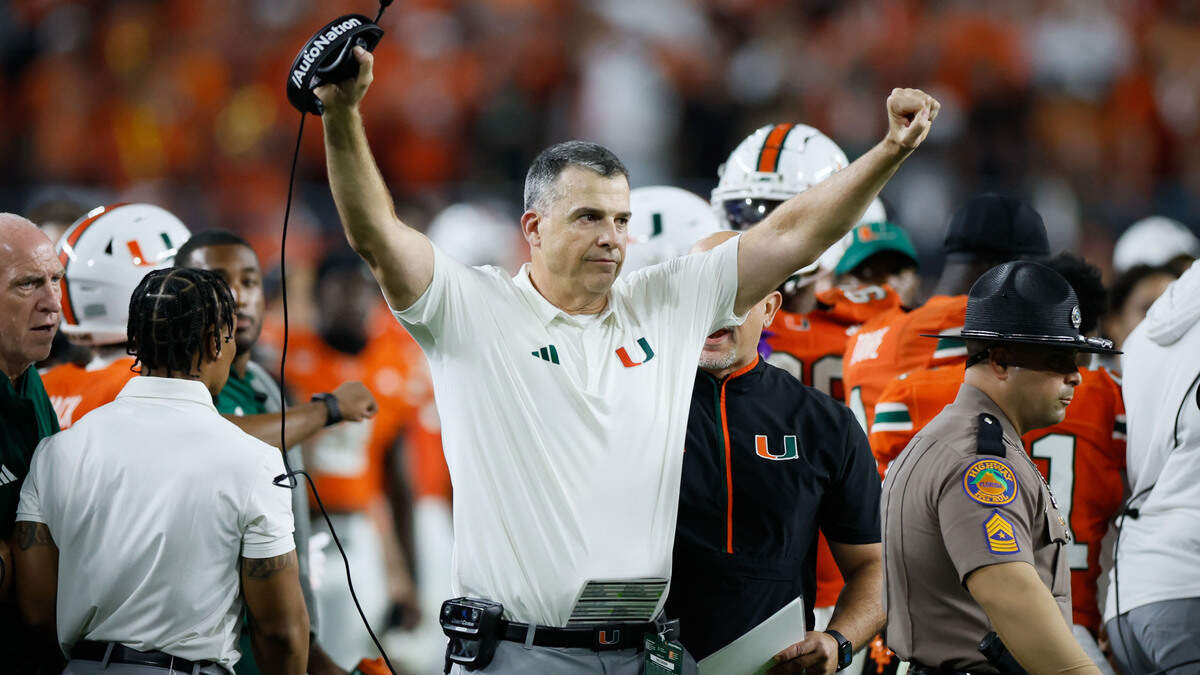
“The rankings only matter,” Hurricanes coach Mario Cristobal said, “when the last game of the season is played.”
And if the Hurricanes want to keep that No. 1 ranking, Cristobal and his coaching staff are well aware they are going to have to play better than they did in their 43-35, double-overtime thriller against the Florida State Seminoles on Saturday at Hard Rock Stadium.
Yes, Miami came away with the win — something so many other top teams failed to do Saturday as five teams ranked in the top seven fell, including three to unranked opponents — but survive and advance is only going to last so long.
Simply put, the Hurricanes know there’s a lot to work on before they host the Pittsburgh Panthers (5-2, 2-2 ACC) on Saturday (noon, ESPN).
Here are three big-picture areas in particular Miami needs to fix.
Cut down the game-altering penalties
Miami committed six first-half penalties against Florida State. This included four personal fouls that all proved costly in their own way.
First was safety Zechariah Poyser being called for targeting on a hit to FSU quarterback Ashton Daniels as he was sliding at the end of a run in the first quarter. Miami’s defense held Florida State off the scoreboard on that drive but lost a key member of the secondary for the remainder of the game after that play.
“It changes a little bit how you call [the game],” defensive coordinator Corey Hetherman said. “Changes a little bit how you attack teams. … We had a couple had a lot of moving parts again. It caught up to us a little bit.”
The other three directly led to FSU points.
The first came when Chase Smith was called for a facemask penalty on third-and-18 that kept an FSU drive alive. The Seminoles scored one play later on a 23-yard touchdown from Daniels to tight end Desirrio Riles to tie the score at 7-7.
Read more Infant’s body found near Fort Worth dumpster; mother faces capital murder charge
And then late in the second half, Miami was called for two 15-yard penalties following a punt with Bobby Pruitt called for a facemask and Keona Davis a personal foul that occurred during a skirmish after the play. The double whammy set FSU up on the Miami 15. The Seminoles scored three plays later to tie the score at 14-14 with 1:40 left in the half.
Miami did not commit a penalty in the second half or overtime, but the damage done early was enough to benefit FSU and help keep the game close throughout.
“We did a poor job in the first half,” Cristobal said. “We really put ourselves in terrible situations. … We were just a little bit wild, a little bit out of character and out of sync. And I think the more that we focused on doing our job and just stayed where our feet were, working one play at a time, I think that the players’ performance in general just became more consistent and led to a better result.”
Get back to limiting explosive plays on defense
Miami’s defense has generally been good at limiting big plays under Hetherman, particularly. In fact, the Hurricanes entered the Florida State game giving up just 12 total plays of at least 20 yards through their first five games of the season.
On Saturday, they gave up eight such plays, including seven through the air. Half of those were touchdowns, including a game-tying 75-yard touchdown from Daniels to Duce Robinson in the fourth quarter that allowed FSU to force the game into overtime.
“We’ve got to do a great job of eliminating big plays,” Hetherman said. “That was the biggest thing that caught up to us this week.”
Win the field position battle
Miami’s average starting field position for 12 drives in regulation against FSU was its 20-yard line. This included three drives starting inside its 10-yard line and only twice started out beyond the 25-yard line.
The Seminoles’ average starting field position on 13 drives in regulation, meanwhile, was its 32-yard line. This included three drives that started near midfield and the drive that started at the Miami 15. Three of FSU’s four touchdown drives in regulation came on those four possessions with a shorter field.
Read more A South Florida Publix sold Monday’s only major money lottery winner









Post Comment