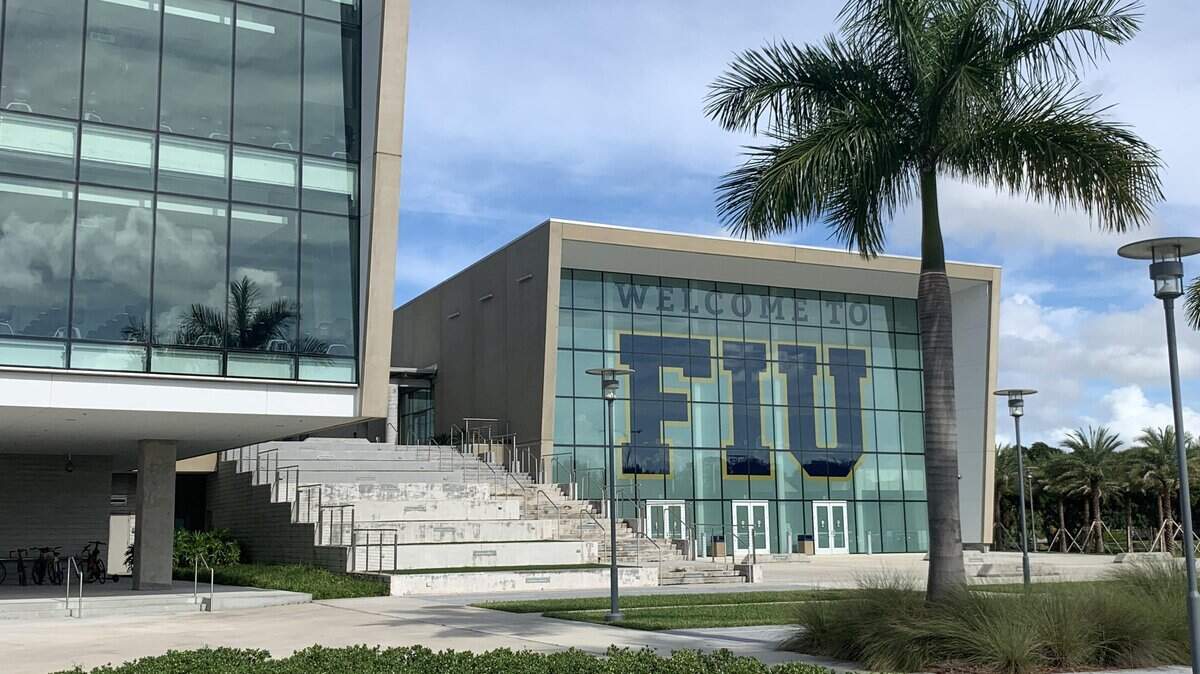
FIU faculty want law school dean sidelined over sanctions tied to Trump lawsuit
Florida International University’s Faculty Senate passed a statement Tuesday urging the school’s administration to put its interim law school dean on leave due to sanctions placed on him by a federal court.
Read more Unsafe food and old food cause a Miami-area supermarket to fail inspection
FIU’s new interim law school dean Daniel Epstein was sanctioned over the summer, essentially barred from appearing in the Southern District of Florida, for his conduct as personal attorney to President Donald Trump. With only two votes in opposition, the vast majority of FIU’s Faculty Senate supported the measure.
The sanctions came as part of U.S. District Judge Kathleen Williams’ ruling that Trump’s lawsuit and proposed settlement with the Internal Revenue Service were “brought for an improper purpose” and amounted to self-dealing since Trump is the current president. Williams blocked Epstein from applying for temporary licenses to appear in Florida court for a year.
He is appealing those sanctions in the United States Court of Appeals for the Eleventh Circuit.
FIU’s administration and Epstein had not respondedto the Faculty Senate’s statement as of Tuesday afternoon.
The statement was presented by Scott Norberg, a professor and founding associate dean when the law school started 25 years ago.
“I would rather be anywhere but here, talking about anything but this… We find ourselves in a very difficult, a very uncomfortable, a very unfortunate place. As far as I can tell, our situation [with] a sitting law school dean under sanction for professional misconduct is unprecedented,” Norberg said.
He was echoing concerns voiced by many members of the faculty as well as prominent former administrators about Epstein.
The statement said “only if [Epstein] is cleared of the findings of professional misconduct should he return to the position of interim dean.”
FIU faculty concerns
Norberg added in remarks to the Faculty Senate that the statement is not meant to assert he acted improperly, given that Epstein may yet prevail in court.
The longtime professor acknowledged that it put Epstein in “an extremely uncomfortable position.” But he and a majority of the body’s members agreed the statement was necessary.
Read more Man City’s Guilty Verdict Puts Players in Awkward Position, But They’re Still Here to Win
“The reputation of a very, very good program that so many have invested so much to build is being tarnished by the spectacle. It is fundamentally untenable for a lawyer who is under court sanction for professional misconduct to be the public face of a program, the very purpose of which is to prepare lawyers for competent and ethical practice in law,” Norberg said.
Though the statement was limited to Epstein’s sanctions, the administration’s selection of him irked some faculty for other reasons. For one, Epstein was not a finalist or even selected for the top 20 among the applicant pool when he applied for the role — Provost Elizabeth Bejar and President Jeanette Nuñez declared the search failed before appointing him in an interim, tenure-track capacity. Some faculty also criticized Epstein’s close ties to Trump adviser and immigration hardliner Stephen Miller as well as his initial cover letter for the role, which suggested leveraging conservative politics for the school’s benefit.
H.T. Smith, a longtime civil rights attorney and founding director of the law school’s Trial Advocacy Program, has spoken out directly against Epstein’s hiring. Williams’ ruling led Smith to call Epstein a “poster boy for ethical corruption.”
Epstein’s appeal
Epstein’s appeal against the sanctions levied against him has been an active effort. Recently, a three-judge panel of the United States Court of Appeals for the Eleventh Circuit refused his motion to pause Williams’ sanctions against him.
Norberg said that, given the court’s existing order on the sanctions, “it would appear to be the most likely outcome” that Epstein’s sanctions are upheld.
Epstein has the support of both the U.S. Department of Justice as well as the office of Florida Attorney General James Uthmeier. Last week the AG filed a brief in support of Epstein’s effort alongside nine other GOP state attorneys general.
The proposed settlement — the case was withdrawn by Trump in May — originally sought to create a $1.8 billion fund intended to benefit Trump’s allies, possibly including people who stormed the U.S. Capitol as part of the Jan. 6, 2021 riots. Williams’ ruling technically blocked Epstein from appearing in the Southern District of Florida “pro hac vice,” which is a mechanism attorneys use to practice law in a state or jurisdiction where they’re not licensed to practice. Epstein is not a member of the Florida Bar Association.
In the amicus brief, Florida Chief Deputy Solicitor General Jason J. Muehlhoff argued that Williams’ sanctions against the attorneys — including the referral of another attorney for Trump, Alejandro Brito of Coral Gables, to the Florida Bar for potential discipline — went too far. They called Williams’ sanctions a “total betrayal of the judicial role.”
“One might respect, or even commend, such an indomitable spirit in an athlete or zealous advocate. But it’s a total betrayal of the judicial role. Enough is enough. The district court failed to act like a court,” Muehlhoff wrote.
Read more Jayden Daniels, Jordan Love, and 2 More Must-Start Quarterbacks in Week 6 Fantasy Football
This story was originally published October 13, 2026 at 4:50 PM.








Post Comment