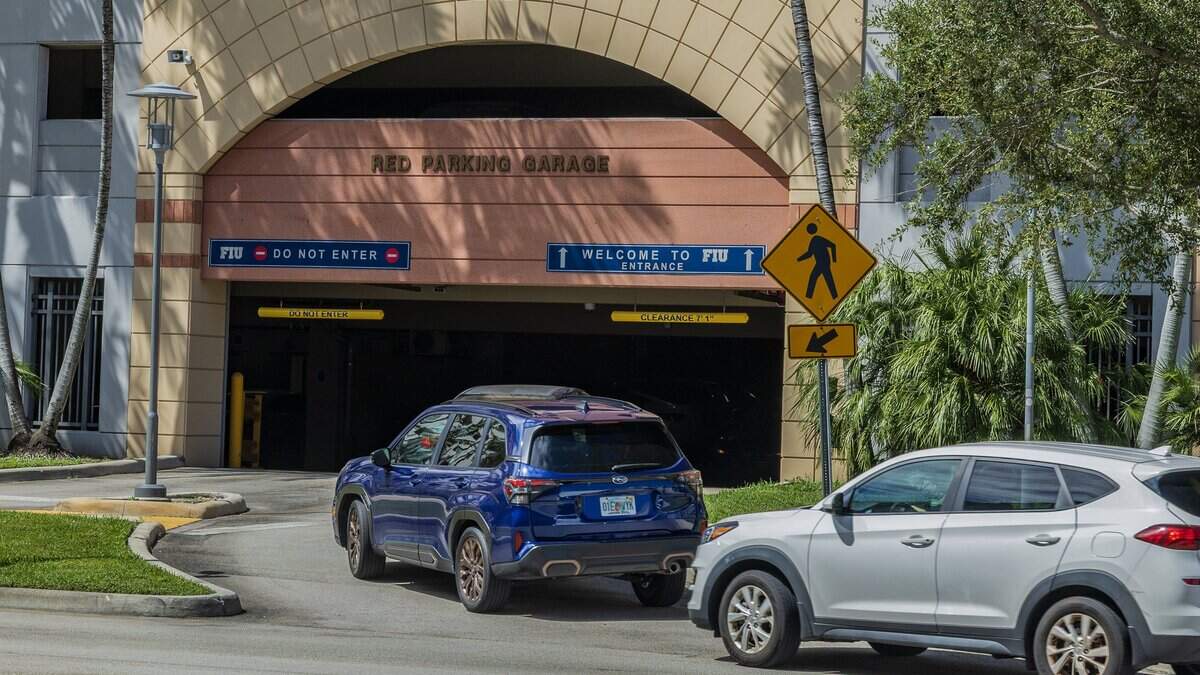
Students drive in circles for campus parking. What are UM and FIU doing about it?
College students have a lot to focus on. Passing classes, taking exams, paying the bills.
Read more Texas Tech football traditions that bring Lubbock, Galaxy Stadium to life
And parking.
The lots at UM and FIU fill up fast with student commuters. And that means lots of circling the campus looking for a spot. About 93% of students at FIU live off campus, according to U.S. News and World Report, with many of them commuting to class.
Many of those students spend half an hour doing laps around campus, waiting for someone to pull out so they can slip into a space and get to class on time.
“UM parking is something else, honestly,” said Georgina Muñoz, a 20-year-old media management student at the University of Miami.
She tries to leave home early to allow time to find a parking spot. But before her midday social media class, she finds herself driving around UM “looking for parking for like 40 minutes.”
“If you go, for example, later in the day before your classes, then you’re screwed,” Muñoz said.
UM student Sophie Libermann told UM’s student newspaper that “finding a parking spot can take literally 20-plus minutes.” Libermann said she parks in the Red Lot, near the School of Nursing and Health Science and the School of Communication, on weekdays, and has the hardest time parking between noon and 2 p.m.
Florida International University has similar issues: lots of commuter students and not enough parking.
Charlotte McLaughlin, a 20-year-old marketing major at FIU, said she finds parking on campus “extremely difficult.”
“I can’t find parking here, so I just have to do laps,” she said.
How is FIU handling parking?
At FIU, students are charged a “transportation access fee” of $95.30 per semester in the fall and the spring, and in the summer the fee is $88.88. Students pay this fee when they register for classes, which gives them a virtual permit they can link to a license plate.
With the virtual permit, students have access to all garages and lots on campus, unlike at UM where they receive a permit for a designated area.
But are they getting what they’re paying for?
Across the two FIU campuses — with a student population of more than 54,000 — 11,927 parking spaces are available, the majority of which are on the main Modesto A. Maidique Campus near Sweetwater in West Miami-Dade.
Peak parking times are Tuesday through Thursday from around 10 a.m. to 2 p.m., according to Tom Hartley, the associate vice president for the Parking and Transportation Department at FIU.
Hartley said he understands the students’ frustrations around parking, and the transportation department is taking a “holistic approach in providing transportation,” including using transit services, signs across campus and constructing additional parking.
At FIU, students can use a variety of transit options to get around campus and to travel from one campus to another. But they generally require students to find parking on campus in the first place.
The Panther Express bus, for instance, takes students from the Modesto A. Maidique Campus in West Miami-Dade to the Biscayne Bay Campus in North Miami. The CATS Shuttle takes students from the Maidique Campus to the Engineering Center about two miles north.
Lots at the center of campus fill faster than those on the campus outskirts. If students can only find parking far from the building they need to get to, they can call a Freebie to take them there, or use the Panthers on Demand service. To use Panthers on Demand, students have to download an app. Then they can request a free ride at any time between 7 a.m. and 11 p.m. to take them where they need to go.
Student Christopher Davis, a 23-year-old studying sports and recreational management, also drives Panthers on Demand ride service vehicles.
“A lot of times, people are going from one end of the campus to the next. They want to get to a class, an exam — however, a lot of them have disabilities and so on, and they need to get there before a certain time,” Davis said. “It just helps that they can just request something with a few taps and get to where they need to go in a matter of a few minutes.”
Read more In the SEC’s Heisman arms race, South Carolina’s George Rogers still stands alone
Technology is key to improving the parking issues, said Brenda Dome, FIU’s director of parking and transportation.
FIU uses 26 electronic signs around campus to notify students which garages are full and help them navigate to available spots. Five of the signs are movable, and the university can change the messaging. They can also be used to flash an emergency.
In the transportation building sits what Hartley and Dome call the “command center,” with screens that show garages and lots around campus, allowing workers to see what parking areas are full to help get students to open spaces.
The command center has “the latest digital electronics that can provide information and real-time data for us to make real-time decisions for our students,” Hartley said. “Our goal is to get that information in the hands of the students, so they can make the best decision.”
Said Dome: “Because we have the technology, and we have the knowledge.”
FIU’s parking department also uses social media and emails to notify drivers of parking availability, construction and the requirement to link license plates to permits.
Hartley said the university is building a new 1,200-space parking garage on campus, with groundbreaking in the next month. The garage is expected to be finished for spring semester 2028.
Hartley and Dome say that getting the message to students is important. Many students at FIU, such as McLaughlin, the marketing major, have never used the transit services the university offers. Some don’t follow the Parking and Transportation Department on social media or check their email for real-time information, and others don’t know that the university is carving out more parking.
What’s UM doing about parking?
At the University of Miami, students buy a permit for a designated area and can only park in that area, or they can get a ticket.
“Permits are assigned to specific zones to help balance demand across campus and support the transportation needs of the university community,” said Peter Howard, the assistant vice president of news and media relations at UM.
According to the Miami Hurricane student newspaper, a parking permit at UM costs $656 per year.
The private university did not respond to questions about how many spots are available to students, how many permits have been issued this year or if the construction of additional parking lots is on the horizon.
“The Department of Parking and Transportation continuously monitors the number of vehicles in all parking locations,” Howard said. “All parking permit zones do show some availability throughout the day.”
Howard said there’s “an abundance of unused parking spots” in the Mahoney-Pearson Parking Garage, and during this fall semester, all permits are eligible to park in the garage. UM also recently rolled out a new feature in the UMiami app. The university advertises that it helps navigate drivers to available parking.
The university encourages students to “plan ahead, allow extra time during peak periods,” Howard said. “The community is also encouraged to explore other transportation options to access campus.”
The UM campus in Coral Gables sits along Metrorail, and students can get off at University Station near U.S. 1 at the edge of campus. Full-time students can get half off the price of the monthly mobile pass for Metrorail and Metrobus and the Easy Card for Tri-Rail, according to the university’s Office of Parking and Transportation website.
Student Muñoz, who noted parking spots are hardest to come by from around noon to 4 p.m., said the U can help solve parking issues with a few simple moves.
“Adding more parking, or at least making parking more convenient,” she said, “and being way more strict on tickets, would be the best thing.”
Read more Two South Carolina college football traditions make the top 25. Where they rank











Post Comment