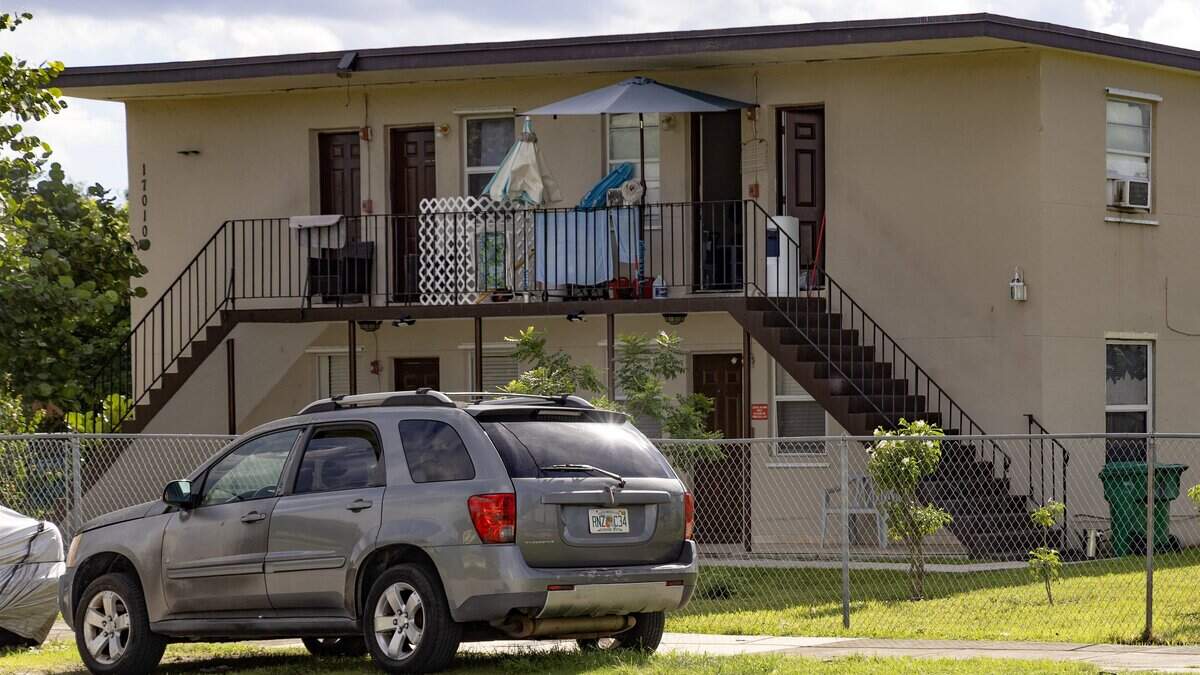
‘Are we back in the Middle Ages?’ State cites mental health ALFs over deaths, care
Adults with severe mental illness were sent to live at Alfonso’s ALF in Miami for their own protection. Community mental health agencies oversaw their care. Florida taxpayers footed the bill.
Read more Gun used in MIA shooting was stolen from car in parking garage, MDSO says
Here’s what the state got for its money:
Health inspectors found one man — unable to communicate with his caregivers due to a language barrier — left untreated on a recliner while he wheezed for four hours. He later died. Another resident died after caregivers made no “immediate” efforts to help him when he, too, couldn’t breathe, state records say.
Living conditions were dreadful: A man was given a pillow with a black garbage bag for a pillowcase. Another man slept with a urinal hanging off his bed, and a bucket underneath to empty the urinal, records say. Residents had no closets, no lamps, no nightstands.
Alfonso’s license was set to expire in August 2024. But for almost two years, it continued to operate, its six beds housing mostly residents with chronic and severe mental illness, while the Florida Agency for Health Care Administration, or AHCA, documented a catalog of violations.
Yet while one state agency was running out of patience with the home, Miami-Dade mental health treatment centers, dispensing Medicaid and other state dollars, had clients living there, and several other homes like it.
At present, the owners of 16 Miami-Dade ALFs that house and care for people with mental illness are litigating with the state to stay open, records show.
“The conditions in these homes are intolerable and despicable,” said former Miami-Dade Mental Health Court Judge Steve Leifman. “But if the state shuts them down, the residents have nowhere to go.”
Alfonso’s was one of the Miami-Dade assisted living facilities that had been in litigation with the state to keep their doors open. The homes — often single-family residences converted into ALFs — are paid to house people with chronic and severe mental illness. Such residents are among the most difficult to manage, and healthcare providers are loath to see the homes shuttered.
“AHCA wants to close these facilities, and they’re being prevented because we need them — albeit with horrific conditions,” said Frank Rabbito, former chief operating officer of WestCare, a national mental health provider with programs in Miami-Dade. “The stalemate has to be broken.
“We are dealing with human beings,” added Rabbito, now the non-profit’s senior executive advisor. “We’re supposed to be better than tolerating bad conditions. We’re supposed to fix them.”
On Sept. 17, board members for Thriving Mind, the privately run mental health service manager in Miami-Dade, discussed their concerns about conditions in assisted living facilities that house people with persistent mental illness. Some members said it’s often difficult to do better with the money the state pays.
“ALFs with a mental health license are far more challenging than one with a regular license,” said board member William Delaney, vice president of Psychcare/Beacon Health Options in Miami. By “regular license,” he was referring to traditional ALFs that house frail elders with dementia and infirmities of aging, but generally not behavioral disorders.
Said Luis Collazo, Thriving Mind’s board chair and director of Palm Breeze Assisted Living Facility, which houses people with mental illness: “There is no other place to put [them]. “It’s a tough population. You can’t put them in a locked-down facility or a psych hospital.”
There is no standard formula for reimbursing ALFs that care for people with mental illness. Rates can vary widely, depending on the funding stream, which can include Social Security or federal disability income, state public assistance programs such as Medicaid, and dollars from community behavioral health organizations.
The current market rate for an assisted living bed in Miami-Dade is around $3,400 to $3,600 per month, said Laura Naredo, Thriving Mind’s CEO.
By contrast, one Medicaid program pays as little as $15.75-per-day — $472.50 for 30 days — for an ALF bed for a behavioral health client. Another Medicaid program for people with mental illness can pay as much as $2,400 per month.
Matching a client with a bed can hinge on “a number of factors, including an individual’s needs, facility capabilities, regulatory requirements and available funding,” Naredo said. But records suggest regulatory requirements have seldom interfered with an ALF’s ability to remain open.
Living in a shed
In recent months, Florida regulators have documented scores of violations at the homes throughout South Florida. Caseworkers at state-funded agencies help place them there; they see the same things inspectors see.
During a visit to one home in January, inspectors found a man — who needed help to walk, bathe, eat, dress, use the bathroom and transfer from place-to-place — living in a backyard electrical and air-conditioning shed at Serenity Breeze ALF, 12200 SW Second St.
Other residents, all with significant special needs, were stashed behind a “hidden door that resembles a mirror with a bookshelf in front at the end of the hallway,” an AHCA report said. Licensed for six, the Miami ALF housed 10.
A woman who identified herself as the home’s owner, but declined to disclose her name, said “what AHCA wrote in that report was not accurate. Nothing AHCA said or did was legal. We’re in litigation, and there is a reason for that.”
At Paradise Villa, a six-bed home in Cutler Bay that houses people with mental illness, a man died when the two caregivers on shift were unable to perform CPR, an AHCA report said.
The man had fallen to the floor from his wheelchair and stopped breathing, the daughter of another resident told inspectors in December 2025 — the date of the incident is redacted in AHCA’s report.
Nobody rendered CPR until rescue workers, responding to a call from the daughter, arrived. “I did not give him [CPR],” one caregiver said. “I panicked…I was very nervous.”
Paradise Villa’s license status also is listed as “in litigation.”
Paradise Villa’s owner declined to comment for this article.
In late June, inspectors reported a “severe” scabies infestation at Green Life Assisted Living in Pompano Beach that affected more than half of 40 residents who were interviewed. The parasitic outbreak, which had gone on for months, caused itching, body rashes and “severe skin irritation,” a report said. One resident also reported bed bugs, though the report said staff didn’t change the bedsheets.
On the day of the inspection, the temperature inside the home, licensed to house 71 residents with mental illness, was 81.3 degrees.
Green Life’s license is listed as “in review.”
“Are we back in the Middle Ages?” asked Broward Public Defender Gordon Weekes, whose office represents indigent clients facing involuntary psychiatric commitment, many of whom are placed in homes like Green Life. “Are we not even attending to basic cleanliness?”
Green Life’s administrator, who would not disclose her name, said the air conditioner broke the morning of the inspection, and was fixed by later that day. She said it was “very common” for ALFs to experience scabies outbreaks, and she believed the parasites were introduced to the facility through a resident who’d been in a nursing home.
The administrator said she expects the home’s license to be cleared following the next inspection.
Small homes, big problems
At one home with a mental health license, NOA ALF, state inspectors counted three toothbrushes in a bathroom that appeared to serve five residents, records show. Inspectors documented hair and debris on the toothbrushes, which were “worn and unclean.” The holders were “dusty and dirty,” with visible residue.
When inspectors asked about them, NOA’s administrator said residents enjoyed using filthy toothbrushes: “I know [the] toothbrushes need to be changed,” the administrator said, “but [the residents] like to have their toothbrushes like that,” a May 19 AHCA report said.
Another inspection found a male caregiver sleeping in a female resident’s room – a “Class 1” violation, among the state’s most serious.
The most severe violations documented that April involved the deaths of three residents. Details of the three deaths are scarce and heavily redacted in the state report, though the inspection says all three residents were “found unresponsive” and later pronounced dead.
Caregivers performed CPR on one of the deceased clients, already long dead, who had signed a do-not-resuscitate order, the report said.
The resuscitation efforts occurred after the woman was “found on the floor pulseless and not breathing,” a report said. When rescue workers arrived, she was already so “stiff” that her arms, bent at the elbow, protruded in the air.
A second resident — none of the clients are identified in AHCA’s report — was in rigor mortis by the time a caregiver found her and began CPR.
A third resident also was found unresponsive in his room. No details are included in the inspection, and the dates of death for all three were removed from the report.
NOA’s owner could not be reached by the Herald for comment.
Though NOA is small at 1,419 square feet, homes like it play an outsized role in Florida’s system of care for both frail elders and younger people with mental illness.
Florida created adult congregate living facilities, now ALFs, in 1975. It was the first state in the country to develop community homes for elders who didn’t need the intensive care of a nursing home.
A decade later, the Legislature agreed to license a subset of homes for the care of people with severe mental illness – thousands of whom were being released from state psychiatric hospitals, largely to save money.
Read more Broward businessman convicted of smuggling nuclear research tech to Moscow
‘Cheap, easy, unregulated’
The policy was considered visionary and humane: People with treatable mental illnesses would be given care outside grim, isolated institutions and live in home-like settings in real communities.
From the beginning, the reality failed to match the promise.
Fifteen years ago, then-Miami-Dade Mental Health Court Judge Leifman called the homes “a cheap, easy, unregulated system of care” filled with dangerous, decrepit homes.
Little has changed, he said in a recent interview, other than his retirement last year. “The most vulnerable get treated the worst,” he said.
It’s no secret, Leifman said, that some of the homes with the worst records stay in business thanks to the largess of the state of Florida, whose social service agencies move residents in, sometimes without their consent.
Naredo, Thriving Mind’s CEO, said state and local health administrators have a responsibility to vet assisted living facilities that accept people with mental illness and special needs. Thriving Mind oversees 40 Miami-Dade mental health agencies.
“They should be doing due diligence to ensure that homes are safe, licensed and meeting standards,” she said.
Ideally, Naredo said, community mental health agencies should receive “alerts” or other warnings when health regulators are trying to strip a home’s license.
“Unfortunately, that doesn’t exist in the state of Florida,” she said. “That definitely is a gap within the system.”
AHCA officials did not respond to the Herald’s queries.
A failure to communicate
AHCA administrators fined Alfonso’s ALF, 17010 SW 100th Ave., 13 times since 2016, for a total of $76,500. And while many of the deficiencies involve record-keeping or other less-serious infractions, some violations represented “an immediate danger to residents… or [carried] a substantial probability that death or serious physical/emotional harm will result,” the state reports said.
Alfonso’s owner did not respond to messages from the Miami Herald and could not be reached.
Beginning in late 2025, Alfsonso’s had been the subject of three scathing AHCA inspections.
An April 20 inspection identified 15 infractions, including six that were among the state’s most severe. Ten of the violations had been uncorrected from a prior inspection.
The next month, health administrators announced they would not renew Alfsonso’s license, citing 31 violations from November 2025 through April 2026, some of them severe.
The notice said residents were living in threadbare conditions, without space to hang their clothes and lacking nightstands and lamps. The home had moved residents into a nearby space that was operating without a license, the notice said.
The most serious allegations involved the deaths of two clients, identified only as Resident 1 and Resident 7. The deaths were detailed in a 79-page administrative complaint AHCA filed against the home.
Resident 1 needed help with virtually every aspect of his daily life: eating, bathing, going to the bathroom, moving around. He required a special diet and help taking his medications.
He fainted on Jan. 1, his eyes rolling back. A cardiologist at a hospital ordered the next day that a prescribed blood pressure medication be discontinued.
But for more than two months, the home administered the drug to him, even increasing its dosage, a report said.
Inspectors arrived at the home early on the morning of Nov. 21, 2025, and found the man sitting at a table “breathing coarsely with a loud wheezing sound.”
When asked if he was alright, the man could only say “wheezing,” one of a few words the Haitian immigrant could say in English. For the next four hours, staff left him in a recliner, waiting for a caseworker to take him for treatment.
While they waited, staff gave him a pill unrelated to his shortness of breath, the report said. And when asked why he administered a heart drug for wheezing, a caregiver replied, “I didn’t care what he said; I made the decision when to give him the medication.”
Staff at Alfonso’s had discussed moving him to a home where he could communicate with caregivers, the report said. Instead, they negotiated an increase in their rent payment with the man’s case management agency from $2,500 per month to $3,000.
The higher rent didn’t pay for a translator.
Two months later, records say that, while again sitting in the recliner, he gasped for air, his “eyes went white, and he slid out of his chair and fell to the floor.”
He died.
Health inspectors claim that the actions of Alfonso’s caregivers also led to the death of Resident 7, who had chronic obstructive pulmonary disease, a life-threatening lung condition, as well as bipolar disorder.
He had trouble breathing on May 9, 2025. When emergency rescue was called, they found him breathing through a nebulizer without medication in it. His oxygen saturation was 50 percent, a level well below the 95 to 100 percent considered safe.
A state report concluded: “The facility failed to make immediate medical arrangements for Resident #7, who was having difficulty breathing, which resulted in the resident being transported to the hospital, where he died.”
The state accused the home of using Wite Out and other methods to alter documents.
In March, AHCA fined the home $20,000, then another $39,500 in May. That month, AHCA informed Alfonso’s owners it would refuse to renew the home’s license. The state closed it this summer.
Say nothing
In southwest Miami-Dade, a neighbor called police after she found the body of a woman drifting in a lake face-down about a mile from Lago Place ALF, a June 13 report said.
The AHCA report suggests the unidentified woman likely had been missing for hours from Lago. A neighbor told police he thought he saw a manatee surfacing on the lake at 5:30 a.m.
When the floating object was identified as a person, the neighbor’s wife asked a Lago caregiver through a language translation app if anyone was missing. She was told no, the report said.
A gated chain link fence between the ALF, on Southwest 52nd Terrace, and the backyard lake had been broken, a report said.
“There was no immediate response by facility staff to search for and account for all the residents in the facility after there was a reported missing person,” the report said.
Inspectors cited the home for failing to “ensure that the facility records [about the incident] were not falsified.”
Lago Place’s owner, who could not be reached by the Herald for comment, also refused to give inspectors video documenting when the deceased woman left the building, the report said.
A resident told health inspectors earlier this month clients were verbally abused and forbidden to speak with state monitors who were investigating a resident’s death.
“Don’t say anything to them,” the owner of the home was overheard telling a caregiver during the investigation.
Though Lago Place’s license is “in litigation,” to stay open, it still houses residents with mental illness under the care of the state.
Miami Herald reporters Ana Claudia Chacin, Shirsho Dasgupta, Milena Malaver and Linda Robertson contributed to this report.
Read more A Netflix ‘Bloodline’ house in the Keys is about to sell. Here’s what to know











Post Comment