FIU faculty question $400k bonus for president as university tightens spending
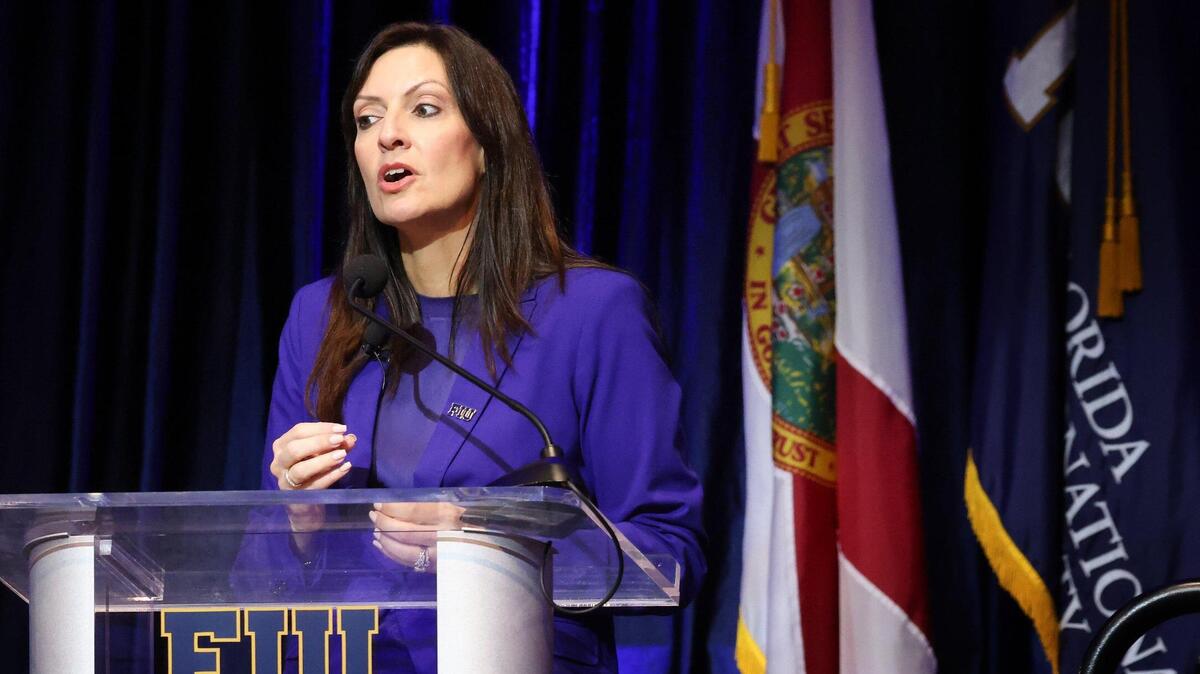
Some faculty members at Florida International University are raising questions about the university’s future — and their own— amid hiring restrictions, a pause on raises and employee buyouts at the school that are happening all while the university’s president Jeanette Nuñez took home a $400,000 bonus package.
Read more Report shows bigger enrollment drop than first-day count for Broward Schools
That was one of several topics discussed by the administration and FIU President Jeanette Nuñez when she addressed the school’s Faculty Senate Tuesday in a meeting that became testy at times.
A professor pointed out that Nuñez was to receive the maximum bonus her contract allowed — $400,000 — at a moment when some employees are feeling the squeeze. for some employees and the university has been offering all employees with more than three years experience, faculty included, buyouts for weeks.
Nuñez said “obtaining recurring dollars” for raises was her administration’s “number one priority.” Faculty had received raises in each of the last four academic years. As for her bonus, she said it was not paid through the school’s core operating budget.
“That was something that was done via my contract, and it is not paid through [the core operating] budget, so, it’s a little bit of a difference. I’m sure it doesn’t matter to you. That’s fine. That’s your right to have your opinion. But we continue to focus on finding efficiencies internally,” Nuñez said of the bonus, which comes from foundation funds.
Nuñez’s bonus was awarded by the FIU’s Board of Trustees last week. That was added on to and a deferred compensation plan of $245,000 per year, not including other covered expenses like housing.
For comparison, the University of Florida’s new president is slated to make $2 million in base salary with a bonus of up to $500,000 and total yearly compensation as much as $3 million.
Administrators, in a presentation to the faculty at the meeting, touted that they’ve moved to restrict hiring and travel, reduce operating budgets and reclaim more unspent money to address the financial squeeze.
Nuñez emphasized her administration’s “direct line” to Tallahassee for financial support, but said that FIU’s relative youth as a state university has forced it to pay close attention to its financial health. Last year, the school saved more and spent less than initially forecasted, .
“There’s nothing we’re doing wrong… FSU and UF have been at the trough for centuries. FIU, as you know, is only 54 years old. So our ability to build that carry forward, our ability to build that base is just a product of our age, not our success,” Nuñez said.
Nuñez’s address to faculty before a Q&A session — the second of her tenure since joining the university early last year — shared mostly good news, highlighting various university rankings on which FIU had performed well – that includes the state performance metrics placing FIU as the highest-performing public university in Florida.
“That is a sore subject around the state university system that FIU gets to tout… because there are some others a little north of here that like to claim they’re the top institution, but not based on the rankings that have been set in statute,” Nuñez said.
Immigration, controversial law school dean and chicharron
Nuñez addressed several other topics in the Q&A session, but did not take questions on one: immigration.
Faculty Senate Chair Noel Barengo informed the group before Nuñez addressed them that she would not answer questions about FIU’s 287(g) agreement allowing campus police to enforce federal immigration law or a group of students’ lawsuit challenging their punishment for protesting it.
Read more Amid whistleblower claims, advocates ask lawmakers to visit ICE office in Miramar
Still, the first question came from Thomas Kennedy, a doctoral student and immigration advocate, who referenced a recent Washington Post article titled “Hispanics flock to this university. It let campus police double as ICE agents.”
“So, my question to you is: When is the university going to exit the 287(g) agreement,” Kennedy asked.
Nuñez responded quickly: “Well, I think you heard Dr. Barengo say because we’re in active litigation, we’re not commenting on that. So obviously, you clearly did not care what Dr. Barengo said.”
One professor asked about the newly appointed interim dean of the law school, Daniel Epstein, a personal attorney of Trump’s who was not in the search committee’s top 20 candidates but was later appointed to the role after leadership called the formal search off. He was sanctioned as part of U.S. District Judge Kathleen Williams’ ruling that spiked Trump’s lawsuit against the Internal Revenue Service – the professor said he imagined he’d be put on administrative leave if he were likewise “accused of serious professional misconduct.”
Nuñez said she stood by Provost Elizabeth Bejar’s decision to bring Epstein on and had no plans to dock him in any way, pointing out that he was appealing Williams’ sanctions.
“I don’t think that has anything to do with his ability to lead the institution, to lead the College of Law… I think we need people that are going to lead the College of Law that are going to have a vision, that are going to have passion for our students to make sure they get employed. Until which time he’s demonstrated an inability to do that, I stand by the provost’s decision,” Nuñez said.
She also briefly described meeting the three finalists identified by the search committee.
“None of the three seemed to be an adequate fit. So [Bejar] declared a failed search, and she went back to the well, and she appointed Dan,” Nuñez said.
But none of these controversial topics caused more tension than the menu of an upcoming tailgate event.
A Jewish professor asked Nunez about the school’s pig roast, scheduled for Sept. 26, which includes competitions in categories like “best chicharron” and “best pig presentation.” The professor said the event was disrespectful to Jews because pork is not kosher, and the event fell on Sukkot, a major Jewish holiday, as well as Shabbat, the Jewish sabbath.
Nuñez, who is Cuban American, “respectfully disagreed,” saying that pig roasts are a Miami tradition. She also took issue with the implication that she would allow an antisemitic event to be hosted on campus.
“And you can laugh and be disrespectful to me, that’s fine, but I am serious in terms of my commitment to combatting anti-Semitism. And speaking of anti-Semitism, I don’t recall this faculty senate taking a position after October 7th. So, we can’t talk out of both sides of our mouth,” Nuñez said.
After Nuñez left, some faculty members said they were taken aback by the way she addressed tough questions. One professor said her tone was “not okay,” while another called it “aggressive.” They also noted that the faculty senate does not often pass statements on major world events, like the Hamas-led killing of 1,200 people in Israel on Oct. 7, 2023 or the more than 73,000 Palestinians killed in the resulting war.
Read more Unclear if shooter will be charged after critically injuring man, deputies say
This story was originally published September 23, 2026 at 3:23 PM.









Post Comment